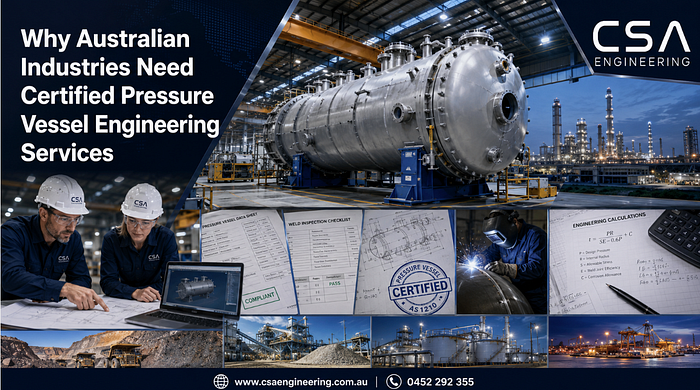
Across the vast industrial landscape of Australia, from the iron ore operations of the Pilbara to the chemical processing plants of the Hunter Valley, one engineering discipline quietly underpins safety, productivity, and regulatory compliance at scale. That discipline is pressure vessel engineering. And for any industrial facility operating under elevated pressure conditions, getting it right is not optional. It is a legal, operational, and moral obligation.
Every year, incidents linked to uninspected, non-compliant, or poorly designed pressure vessels cause significant financial losses, operational shutdowns, and in the worst cases, devastating workplace injuries. Against that backdrop, the demand for pressure vessel certification Australia has never been more urgent. CSA Engineering exists to meet that demand with rigour, expertise, and a genuine commitment to industrial safety across the country.
Pressure vessels are used across an extraordinary range of Australian industries. Mining operations depend on high-pressure separators and storage tanks. Manufacturing facilities rely on autoclaves, heat exchangers, and boilers. Oil and gas platforms operate complex pressure containment systems in harsh marine environments. Chemical processing plants handle volatile substances under tightly controlled pressure. Energy generation facilities manage steam systems that power entire grids.
In every one of these settings, a failure is not a minor inconvenience. It can be catastrophic. The engineering teams responsible for designing, certifying, and maintaining these systems carry enormous responsibility, and choosing the right partner matters deeply. Pressure vessel design services from a certified, experienced consultancy translate directly into safer workplaces, smoother operations, and full regulatory compliance under Australian standards.
Australian law is explicit on this point. Under the Work Health and Safety Regulations and the relevant Australian Standards including AS 1210 and AS 4024, pressure vessels must meet strict design registration, inspection, and certification requirements before they are commissioned and throughout their operational life. Facilities that skip or delay compliance risk significant penalties, forced shutdowns, and exposure to liability in the event of an incident.
What makes pressure vessel certification Australia particularly complex is the intersection of federal and state-based regulatory requirements. An operation in Queensland faces different administrative processes than one in Western Australia or New South Wales, even when both are working toward the same technical standards. CSA Engineering has deep familiarity with this regulatory landscape across every Australian jurisdiction, making the certification process significantly smoother for industrial clients.
Great engineering is never purely about compliance. It is about building systems that perform reliably, efficiently, and safely across their full design life. When a facility engages professional pressure vessel design services, the benefits extend well beyond a certificate on the wall.
Proper design accounting for material selection, pressure ratings, thermal expansion, corrosion allowances, nozzle reinforcement, and support structures results in vessels that perform optimally without the costly unplanned maintenance events that plague facilities that took shortcuts at the design stage. For Australian industries operating in remote or challenging environments, this reliability is not just commercially valuable. It is critical to keeping workforces safe and operations running without interruption. CSA Engineering brings this level of technical depth to every project it undertakes.
Large-scale industrial projects in Australia typically involve multiple engineering disciplines working in parallel. Within that ecosystem, pressure vessel design consultants play a uniquely integrative role. They bridge the gap between process requirements and physical design reality.
They translate operating conditions, fluid properties, temperature ranges, and safety factors into detailed engineering specifications that can be fabricated, inspected, and certified. They communicate with regulatory bodies on behalf of their clients and ensure that every step of the design and documentation process satisfies Australian Standards. When something unexpected arises during detailed design or construction, experienced pressure vessel design consultants resolve it efficiently, avoiding costly project delays. CSA Engineering provides this high-level consultancy support to clients across mining, manufacturing, energy, and industrial infrastructure.
Risk management is at the heart of every credible engineering engagement in Australia. Pressure systems sit within a framework of hazard identification, risk assessment, and engineering controls that collectively protect workers and the public. CSA Engineering supports clients through this entire compliance journey, from initial hazard identification through to design verification, fabrication oversight, and in-service inspection planning.
For industrial operators, demonstrating a documented compliance pathway is increasingly essential, not just for regulators, but for insurers, financiers, and major clients who require evidence of engineering due diligence.
Certification is not a single event. It is an ongoing process that spans the life of a pressure vessel. At the design stage, engineering calculations and drawings must be reviewed and registered. At the fabrication stage, weld inspections, non-destructive testing, and hydrostatic pressure tests confirm that the vessel has been built to specification. Once in service, periodic inspections confirm ongoing fitness for purpose.